Meme Coin Trading, A $22,000 Single Trade Breakdown
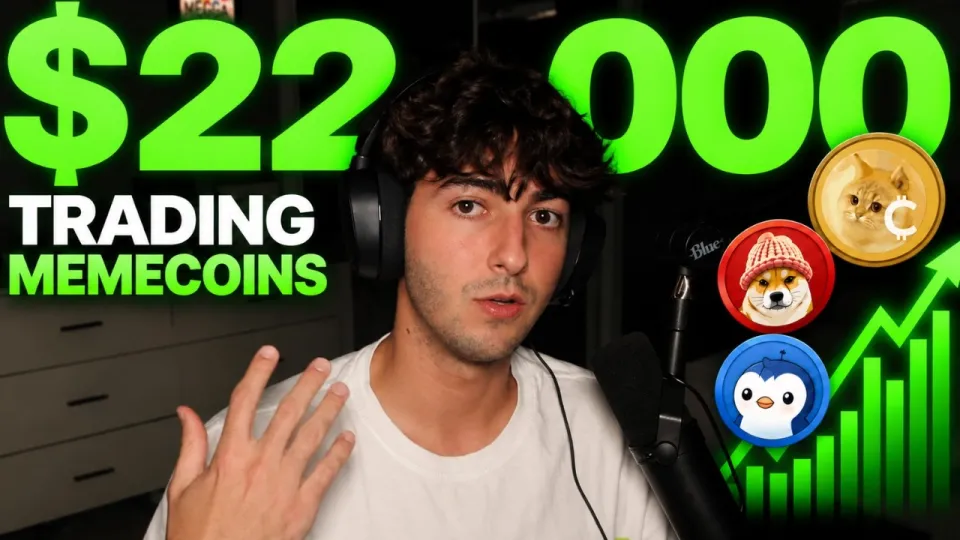
Video: How I Made $22,000 in a SINGLE Memecoin Trade (FULL GUIDE)
Want articles like this for your own video to promote it on YouTube and Google? Order them through the Telegram bot @sat_sit_bot. The bot writes and publishes the articles itself (with your YouTube video embedded) on popular topical websites (no ads). Your first 50 articles are free.
· based on the channel Megga
Key takeaways
- Megga reports a $22,000 profit from a single meme coin trade, detailed in a full guide published on 11 September 2026.
- The method rests on early entries into new launches, small initial size and scaling out into strength rather than one exit.
- A free beginners guide is offered at https://whop.com/wiredd, with trading done through the Padre terminal at https://trade.padre.gg/rk/megga.
- Viewers questioned whether the result is repeatable outside a KOL network, which is the core risk of copy-trading meme coin calls.
- Most meme coin losses come from thin liquidity, honeypot contracts and late entries after a token has already run.
A meme coin trade can turn a few hundred dollars into five figures, and Megga's breakdown of a $22,000 single trade shows the mechanics behind one such result: an early entry into a fresh launch, a small initial position, and a staged exit into rising volume instead of one all-or-nothing sell. The full guide, published on 11 September 2026, pairs that walkthrough with a free beginners guide for new traders, which covers wallet setup, chart reading and the basics of trading meme coins on Solana-style launchpads.
The number matters less than the structure. A $22,000 outcome on a single meme coin is the product of position size, timing and exit discipline, not a secret indicator. Below is how that structure works in practice, what the trade depends on, and where the same setup goes wrong for most retail traders.
What a $22,000 meme coin trade actually requires
A five-figure meme coin result requires a token that multiplies several times after entry, a position large enough for that move to matter, and an exit that captures most of the run. In Megga's case the trade was executed through the Padre trading terminal, a tool built for fast execution on new Solana launches, with the link shared as https://trade.padre.gg/rk/megga.
The arithmetic is unforgiving. A $500 entry needs a 44x to reach $22,000 in gross profit; a $2,000 entry needs roughly 11x. That means the realistic path to a five-figure single trade is a mid-sized position in a token that does 10x or more, which only happens on low-cap launches in their first hours. It also means the downside is symmetric: the same $2,000 position can go to zero in minutes if liquidity is pulled.
Three conditions have to line up before entry:
- A launch with real volume and a growing holder count, not a dead chart with a handful of wallets.
- A contract with no mint authority, no freeze authority and no hidden tax on sells.
- A position size small enough that a total loss does not end the trading week.
The entry and exit playbook behind the trade
Entry comes from scanning new launches for momentum and clean contracts, and exit comes from selling in tranches as price rises. Megga's approach, as presented in the guide, is built around acting early and taking profit in pieces rather than trying to call the top.
A practical version of that playbook:
- Screen launches by volume and holder growth in the first minutes, ignoring anything with a concentrated holder list.
- Buy a starter position only after checking the contract on a scanner for mint and freeze permissions.
- Set a first sell at 2x to recover the initial capital, then scale out in thirds at higher multiples.
- Keep a runner only with house money, and accept that most launches will not produce the move you want.
The $22,000 figure came from one trade that worked. The same process produces many small losses and break-even exits, and any honest meme coin strategy is judged on the sum of those outcomes, not on the best single screenshot.
Risk controls that keep a single trade from wiping an account
Risk control in meme coin trading means capping the amount at risk per launch and assuming any position can go to zero. The most common failure is not a bad pick but a position so large that a normal drawdown forces a panic sell at the bottom.
Concrete rules that fit the style of trade described in the guide:
- Risk no more than 2–5% of trading capital on any single launch, so a run of five losers costs a fraction of the account.
- Use a dedicated wallet funded only with money allocated to speculation, never a main wallet holding long-term assets.
- Check liquidity depth before sizing: a token with $30,000 of liquidity cannot absorb a $5,000 exit without heavy slippage.
- Pre-plan the exit multiples before buying, because decisions made mid-candle are usually emotional.
- Watch for honeypot behaviour on a tiny test sell if the contract looks unusual.
These controls do not make a $22,000 result typical. They make the downside survivable, which is the part that determines whether a trader is still active after fifty launches.
Why KOL traders get results that are hard to copy
Copying a well-known trader's meme coin calls rarely reproduces their returns because their edge includes distribution, not just chart skill. This is the most consistent doubt raised around videos like this one, and it deserves a direct answer.
A trader with a large following can enter a low-cap launch early, announce it to an audience, and sell into the demand that follows. Their fills are better, their exits have buyers, and their information about upcoming launches often arrives before the public chart moves. A retail trader entering after the announcement is buying at a higher price from the very people who front-ran the call.
That does not make the playbook useless. It means the transferable parts are the mechanics: contract checks, position sizing, staged exits and wallet hygiene. The non-transferable part is the network. Anyone following calls should assume they are the exit liquidity unless they have independently verified the setup.
Common questions and doubts from traders
Traders watching the breakdown raised several practical concerns worth addressing directly. The most frequent is whether smaller accounts can run the same process, and the answer is yes, with adjusted sizing: a $100–$500 account can apply identical entry and exit rules, just with smaller absolute profits and the same percentage risk.
The second concern is access. Some viewers outside the US and Europe cannot open certain course links or trading tools because of regional restrictions, so it is worth testing the signup flow and the terminal before committing capital. The third is scope: meme coins are one segment of a wider market that also includes tweet coins and community coins, each with different launch mechanics and different risk profiles, and none of them should be traded before the contract-check routine is automatic.
The final doubt is about authenticity. Claims of large single-trade profits are common and rarely audited, so treat any published figure as a case study rather than a benchmark, and verify every tool and contract yourself before risking money.
Tools and links from the breakdown
All links referenced in the guide are listed here for convenience: the free beginners guide, the trading terminal at https://trade.padre.gg/rk/megga, and the creator's channels at http://www.twitch.tv/megga, https://www.tiktok.com/@meggafaze and https://twitter.com/megga.
Bottom line on the $22,000 meme coin trade
A $22,000 single meme coin trade is possible, but it is the tail end of a distribution of outcomes, not a repeatable monthly target. The repeatable parts are the process: verify the contract, size the position so a zero does not hurt, sell in tranches, and treat every call from a large account as a trade you are probably late to. Megga's video breakdown is useful precisely because it shows the mechanics of one such trade end to end, and the free beginners guide is the logical starting point for anyone who wants to learn the routine before risking real capital. Start small, document every trade, and let the process, not one lucky launch, decide the result.
Questions & answers
Can a small account replicate a $22,000 meme coin trade?
Not the dollar figure, but the process yes. A $200–$500 account can apply the same contract checks, entry timing and staged exits; the percentage returns can match, while absolute profit scales with capital. Expect a long run of small losses and break-evens around any large winner.
How do I check whether a new meme coin is a scam?
Use a contract scanner to confirm there is no mint authority, no freeze authority and no sell tax, then check the holder distribution for a single wallet holding a large share. Do a tiny test sell before sizing up, and avoid tokens whose liquidity is unlocked and controlled by one address.
Why do traders with large followings seem to win more often?
Their edge includes distribution: they enter early and their audience provides the buying pressure they sell into. A retail trader acting on a public call is usually buying at a worse price. Copy the mechanics such as sizing and exits, not the calls themselves.
What is the difference between meme coins, tweet coins and community coins?
Meme coins are launched around a joke or narrative, tweet coins are tied to a specific social post or account, and community coins are built around a group with ongoing participation. Each has different launch mechanics and liquidity behaviour, so the contract-check routine should be run before trading any of them.
Source: How I Made $22,000 in a SINGLE Memecoin Trade (FULL GUIDE) · Markdown version